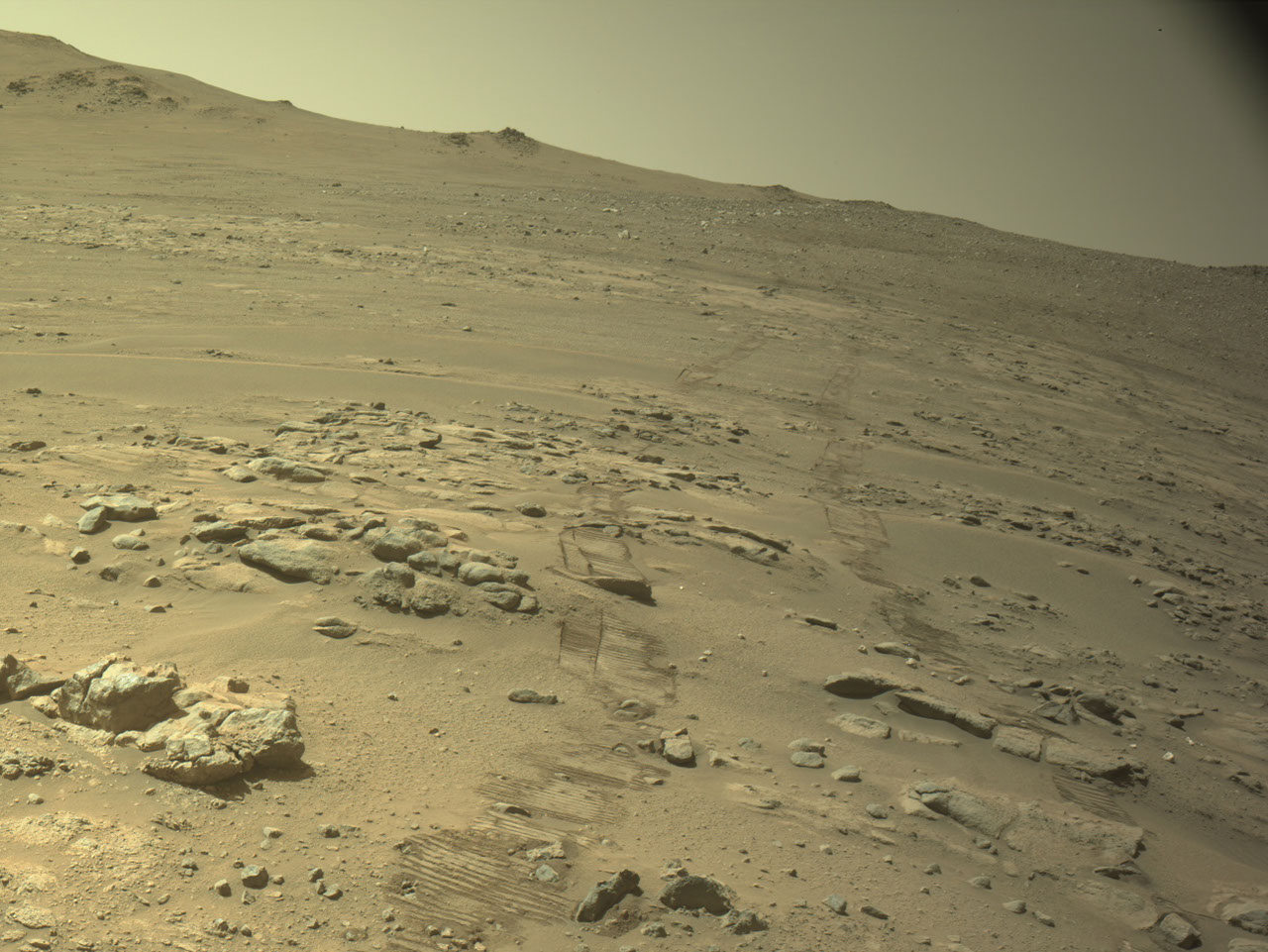
NASA’s Perseverance rover has set a new off-world driving record on Mars, surpassing the mileage of its predecessor Opportunity. Operating on the Red Planet since 2021, the car-sized robotic explorer reached 28.1 miles on October 11, backed by advanced autonomous navigation software that handles most of its daily travel.
Perseverance Breaks Opportunity’s Mileage Record on Mars
On October 11, the six-wheeled Perseverance rover hit an odometer reading of 28.10 miles (45.22 kilometers) during the 2,006th Martian day, or sol, of its mission. That milestone eclipsed the record of 28.06 miles set by NASA’s Opportunity rover, which surveyed the Martian surface from 2004 to 2018.
The achievement marks a dramatic difference in pace between the two robotic missions. While Opportunity needed nearly 15 years to log its record-breaking distance, Perseverance reached its new high-water mark in roughly five and a half years.
Both vehicles have now traveled farther than any lunar transport. Among active missions, the agency’s older Curiosity rover, operating in Gale Crater since 2012, has logged more than 23.65 miles.
Autonomous Navigation and Onboard Processing Drive the Milestone
NASA attributes much of the rover’s speed and endurance to its self-driving software system, AutoNav. Steven Lee, project manager for the Perseverance and Curiosity rovers at the Jet Propulsion Laboratory in California, noted that roughly 90% of the vehicle’s drives occur without human intervention.
Perseverance has set a new off-world record! 🏅On Oct. 11, the rover's odometer hit 28.10 miles (45.22 kilometers), eclipsing the distance record set by NASA's Opportunity rover. 1/2 pic.twitter.com/IThlI7dl2z
That autonomy relies on a dedicated co-processor called the Vision Compute Element, which processes terrain images nearly continuously. Earlier robotic explorers had to pause and wait for ground controllers to evaluate routes before every short drive segment. Where Sojourner assessed its path using 20 measurement points during its 1997 mission, Perseverance analyzes 600,000 points with every look.
Rover Explores Lac De Charmes Toward Rainbow Falls
The record-breaking drive occurred as the rover rolled across Lac de Charmes, a region near the western rim of Jezero Crater, while traveling toward an area named Idubi. Scientists are studying the local terrain for clues about ancient planetary history, including 4-billion-year-old impact-generated rocks and potential signs of ancient microbial life discovered in river-channel sediments last year.

Mission managers recently extended operations to explore the crater rim until roughly the end of 2028. Future plans include heading south toward Rainbow Falls, a 328-foot-wide block of ancient crust uplifted during the impact that formed Jezero Crater.
Engineering assessments indicate the rover's hardware remains strong. Its plutonium-based power system is performing as expected, and mobility mechanisms are undergoing testing to determine if the hardware can sustain cumulative distances between 93 and 186 miles.
Setting records is just a bonus. Longer drives are putting more geological diversity within reach faster, taking the rover from an ancient lakebed up a fossilized river system and onto a crater rim, where an entirely different ancient habitat may await. https://t.co/YgiFA6ZMsn
Lee added that a recent evaluation concluded all systems are capable of operating well into the 2030s and likely beyond.